See before you react.
Attention is the operational resource that separates signal from noise. When every input can seize it, choice quietly becomes reaction.
 MonkOS field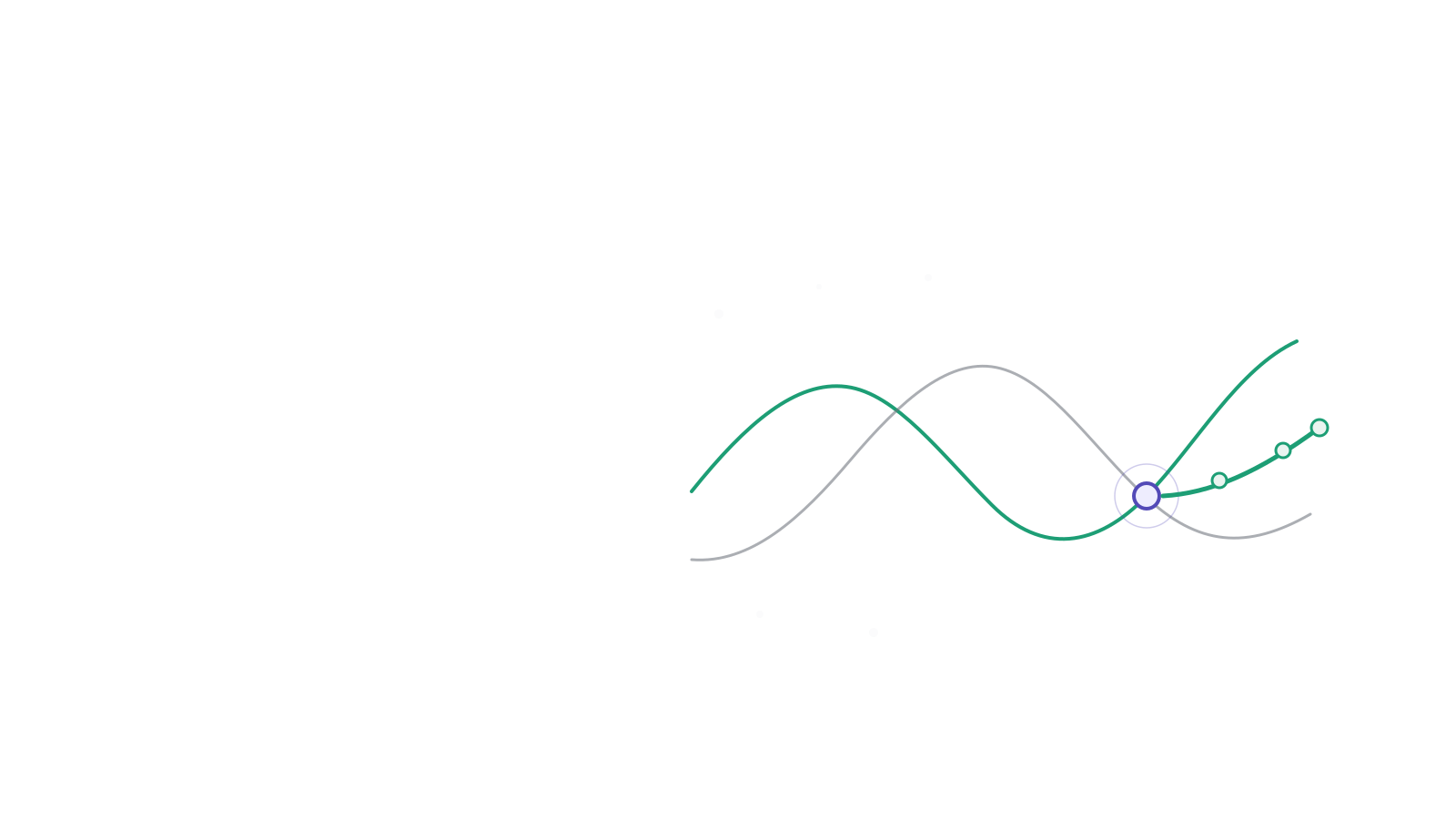
monkos.net · monk open system
Attention is the last sovereign territory.
Preserve authorship. Reduce ΔΨ. Turn intention into coherent action.
NOISE → ATTENTION → ΔΨ ↓ → SIGNAL → ACTION
Initialize ΔΨTechnology promised to give us more time. Instead, many systems learned to compete for every remaining second. Information multiplied while meaning became harder to find. Collaboration accelerated, yet people began spending more energy managing noise, defending roles, and proving that they were working than actually creating.
MonkOS begins with a different premise: attention is not a commodity. It is the medium through which a life, an idea, or a community becomes coherent.
MonkOS means Monk Open System. One practical reading is an operating system of attention.
MonkOS is an open conceptual and methodological framework for separating signal from noise, preserving the provenance of ideas, reducing unnecessary friction, and allowing meaningful work to take form. It remains open because a stable framework must be capable of receiving meaningful change.
What begins as a small shift in attention can become a method, a collaboration, or an ecosystem. MonkOS provides the shared architecture behind Humanika, Vasionica, Trajon Theory, Semonika, Humanofil, and Monkdroid — distinct fields connected through coherent relations.
How can knowledge, technology, and action remain in service of human meaning?
Enter the field. Follow the signal. Keep what restores coherence.
Why MonkOS exists
Technology multiplied information, speed, and productive capacity. But a system can become more powerful while the human inside it has less time, less attention, and less room to choose. MonkOS starts there: protect the capacity from which a meaningful response can still arise.
Attention is the operational resource that separates signal from noise. When every input can seize it, choice quietly becomes reaction.
A need can be real and a solution can exist, yet nothing happens if the system cannot carry the next action. Capacity is the space in which possibility can answer need.
Coherence is not stillness. It is the ability to preserve relation, direction, and recognizability while something meaningful changes.
“A stable framework is one that can receive meaningful change.”
Form is not the master of meaning. Good form reduces unnecessary friction, gives participants a shared protocol, and keeps the frame stable enough for real difference to remain possible.
Open Tomorrow
More time. More attention. More capacity. More choice. The point is not to make the human more efficient for the system. The point is to keep enough human capacity outside automatic reaction to choose what comes next.
From familiar problems to an open system
It was inevitable that your search for meaning and ways to optimize attention would lead you to MonkOS. :)
People do not usually search for MonkOS. They search for information overload, loss of focus, digital wellbeing, human-centred AI, decision ownership, trustworthy collaboration, or ways to retain control as systems become more complex. These are not interchangeable subjects. MonkOS connects them at the point where information becomes attention, attention affects capacity, and capacity determines whether a person can still choose and act.
Attention management asks how focus can be directed. Digital wellbeing asks how technology affects the conditions of everyday life. Information overload describes a practical limit: a system receives more input than it can interpret or use without losing continuity.
MonkOS does not reduce these problems to productivity. Attention is the operational resource by which experience is selected from Noise and given enough duration to influence the next state. The aim is not perfect silence. It is to preserve enough attention and Capacity for choice.
Systems thinking follows relations, feedback, constraints and consequences across a whole. Knowledge management organizes information, but stored information does not automatically become usable knowledge or chosen action.
MonkOS asks whether a system can receive meaningful change without losing relation, direction and recognizability. Coherence is not immobility. It is organized change. That is why provenance matters: decisions remain traceable, conceptual sources remain visible, and contributors do not lose authorship as work moves through a larger system.
Human-centred AI, human-in-the-loop design and meaningful human control all ask who defines goals, interprets outputs, owns decisions, and can interrupt or revise a process.
MonkOS does not confuse automation with augmentation. A machine can automate a task. Augmentation emerges when the relation expands the human field of action. For that relation to remain human-directed, its boundaries must be understandable, feedback must return to the participant, and human initiative must remain capable of stopping, correcting or changing direction.
MonkOS makes the path explicit: NOISE → ATTENTION → ΔΨ → TONUS → TAKT → CAPACITY → CHOICE → ACTION.
Signal can be registered without meaning. Attention selects what receives enough duration to influence the next state. ΔΨ names the smallest operational change of attention sufficient to alter the subsequent flow. Tonus is readiness for the next action. Takt is a functionally complete process step, not a fixed duration. Capacity is the space in which possibility can answer need without loss of coherence.
MonkOS is not a diagnosis, a productivity programme, or a replacement for these disciplines. It is an open conceptual and methodological framework connecting attention, provenance, human agency and coherent action.
Applied field · current work
One framework. Different scales.
MonkOS is entering real constraints through human-directed robotics, control logic, and an operating framework now moving through a large engineering organization. The material changes. The discipline remains: signal, ownership, action, feedback, learning, and meaningful human agency.
MONKOS · FLOW